Flag of Albania: What the Double-Headed Eagle Means and Where It Came From
A red field and a black double-headed eagle: where the symbol comes from, how the flag was raised in Vlorë in 1912, how the communist version differed and how to make the eagle with your hands.

Contents8 sections
- What the Albanian flag looks like
- What the double-headed eagle means
- The history of the flag: from Vlorë to 1992
- 28 November 1912 in Vlorë
- How the flag changed in the 20th century
- The coat of arms and the anthem
- Flag Day, 28 November
- The eagle gesture: how it is made
- The Albanian flag and the flag of Kosovo
- FAQ
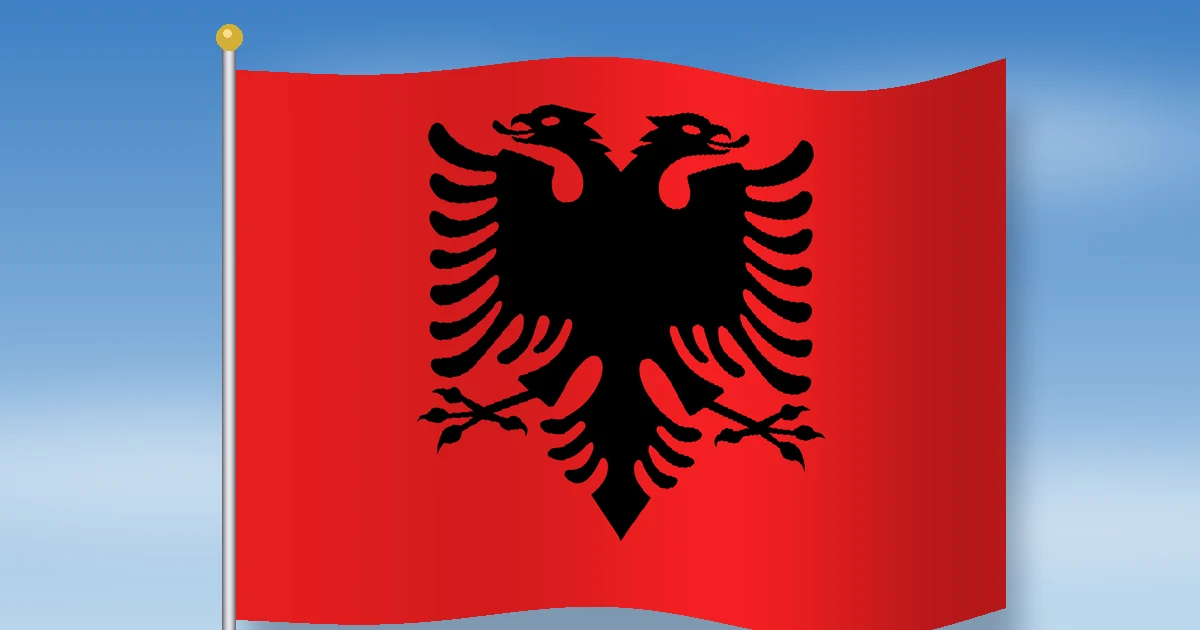
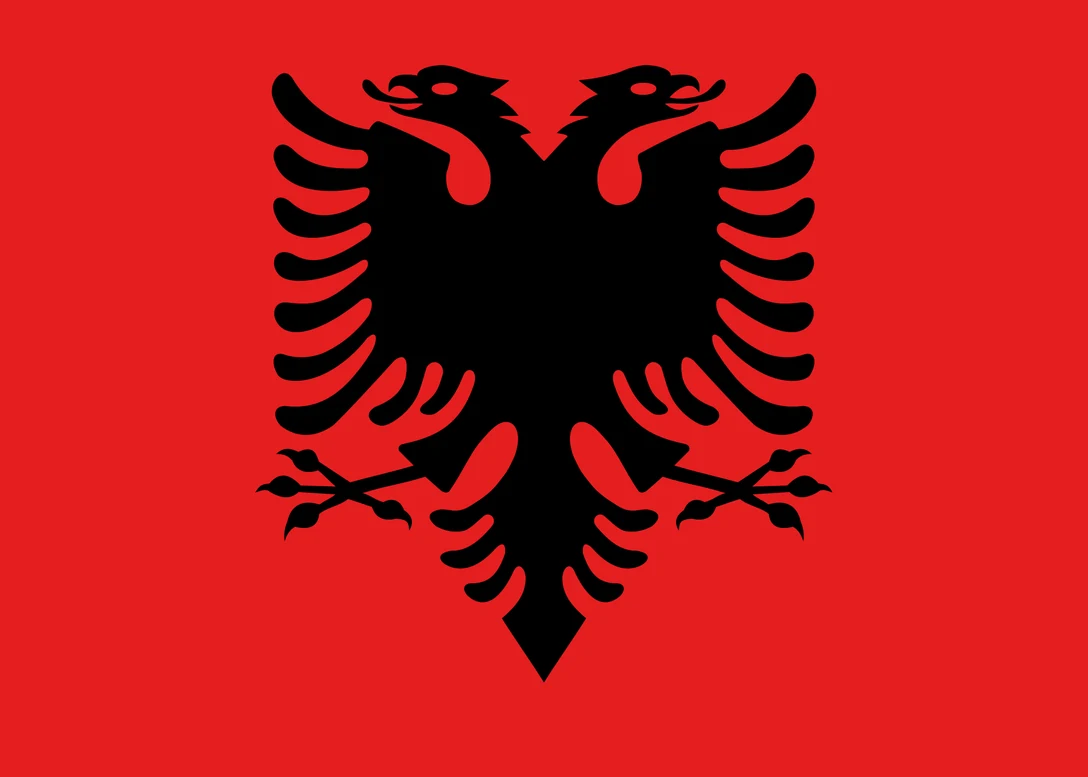
The Albanian flag shows a black double-headed eagle on a red field. Article 14 of the Constitution describes it as follows: “The national flag is red, with a black double-headed eagle in the middle.” The Albanian eagle goes back to medieval princes and Skanderbeg, while the flag took on its present form on 7 April 1992, when the communist star was removed.
Read on to find out what is known about the eagle for certain and what is legend, how the flag changed in the 20th century, when Albania celebrates Flag Day and how Albanians make the eagle with their hands. Along the way you'll pick up a few words: “flag” in Albanian is flamur.
What the Albanian flag looks like
The field of the flag is red; the 2002 law on national symbols calls it “blood red”. In the centre is a black double-headed eagle with outstretched wings: nine feathers on each wing and seven in the tail. The flag's proportions are 5:7, so it is 1.4 times as long as it is high.
The law does not set exact shades as Pantone codes: the colours are described in words. That is why the red on factory-made flags can be anything from scarlet to almost burgundy.
In messaging apps, the Albanian flag is the 🇦🇱 emoji. It is made up of two letters, A and L, which form the country code.
What the double-headed eagle means
The double-headed eagle came to the Balkans from Byzantium. In the Middle Ages, noble families who received Byzantine titles put it on their coats of arms, and Albanian princes were no exception. A black double-headed eagle on red was the coat of arms of the Kastrioti family, to which Skanderbeg belonged. Some members of the Dukagjini and Arianiti families also used double-headed eagles. That is why the Albanian eagle looks like the eagles on the coats of arms of Russia, Serbia and Montenegro: they all share one source, Byzantium.
Skanderbeg (Gjergj Kastrioti, 1405–1468) put the eagle on his seal. Albanian tradition holds that on 28 November 1443, after taking the fortress of Krujë, he raised a red banner with a black eagle over it. Historians accept that Skanderbeg left Ottoman service and took Krujë in 1443, but the date and the story of the banner are legend: no documents from the time are known to mention them. How Skanderbeg held off the Ottomans for a quarter of a century is told in our chapter on Skanderbeg.
The colours have no official meaning: neither the Constitution nor the law explains them. Most often people say that red stands for courage and the blood shed for freedom, and black for steadfastness. The two heads are sometimes read as looking to the East and the West. These are popular interpretations; the law says nothing about them.
The history of the flag: from Vlorë to 1992
28 November 1912 in Vlorë
According to Albanian tradition, the eagle flag was raised for the first time in centuries on 6 April 1911, when Dedë Gjon Luli hoisted it on Mount Deçiq during an uprising in the north. Albania's independence was proclaimed in Vlorë on 28 November 1912. That same day Ismail Qemali, the head of the new government, raised a flag with a black double-headed eagle over the town. Historians still argue about who sewed that flag and how it reached Vlorë. Tradition says it was embroidered by Marigo Posio, but there are other versions, and the original has not survived. You can read more about those events in our article on how Albania became independent.
That is why 28 November is a double celebration in Albania. The Constitution calls it Flag Day (Dita e Flamurit), but in everyday speech it is Independence Day.
How the flag changed in the 20th century
The black eagle on red was always there; what changed were the emblems around it.
| Years | What was on the flag |
|---|---|
| 1912–1914 | a black double-headed eagle on red, with no other emblems |
| 1914 | Wilhelm of Wied's principality: a five-pointed star above the eagle (accounts of its colour differ) |
| 1920–1928 | the eagle without emblems again, including under the republic of 1925–1928 |
| 1928–1939 | King Zog's kingdom: Skanderbeg's golden helmet above the eagle |
| 1939–1943 | Italian occupation: the eagle on a shield beneath the helmet, flanked by fascist fasces |
| 1946–1992 | a red five-pointed star with a gold border above the eagle |
| from 7 April 1992 | the star removed: this is the current flag |
In 1943–1946 the flags changed, and descriptions of them differ.
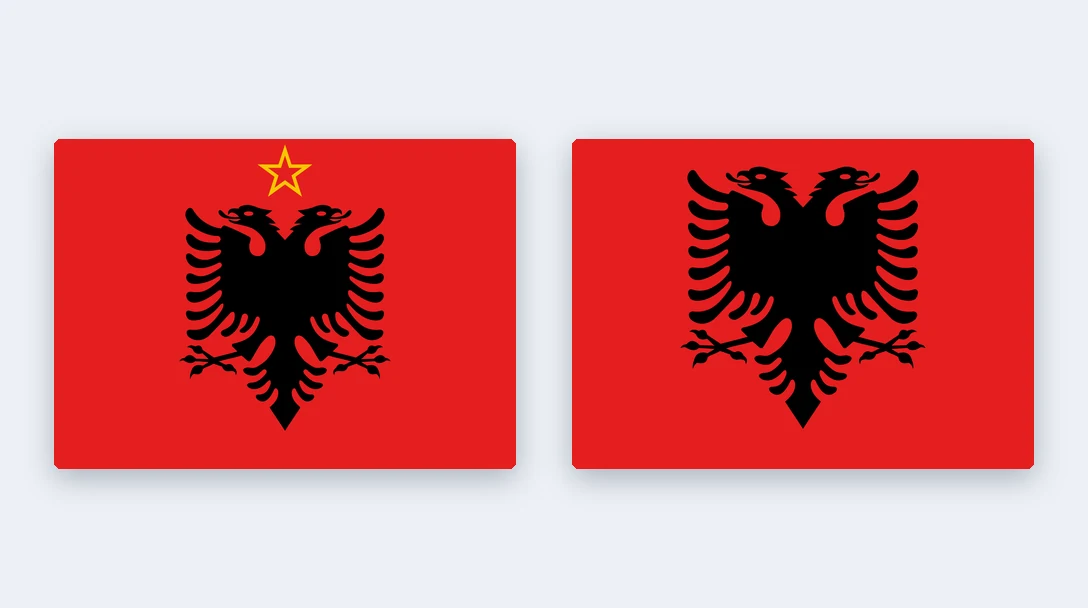
The star was removed on 7 April 1992: the new People's Assembly, elected after the fall of communism, voted for a flag without it. The same vote abolished the communist coat of arms. To find out how the country lived under the red star, read our article on communist Albania.
The coat of arms and the anthem
Albania's coat of arms echoes the flag: a black double-headed eagle on a red shield and, above the shield, Skanderbeg's golden helmet bearing a goat's head. This is not an artist's invention. The helmet attributed to Skanderbeg is kept in Vienna, in the armoury of the Kunsthistorisches Museum. The coat of arms is enshrined in the 1998 Constitution.
The national anthem is dedicated to the flag too. It is commonly known as the “Hymn to the Flag” (Himni i Flamurit), while the Constitution names it by its first line. The words were written by the poet Asdreni (Aleksandër Stavre Drenova) in Bucharest in 1912. The music was borrowed from the Romanian composer Ciprian Porumbescu: it is the tune of his song “On Our Banner Is Written ‘Unity’”. The song became the national anthem at independence in 1912.
Flag Day, 28 November
Albanians celebrate 28 November wherever they live: in Tirana and Vlorë, in Pristina and Tetovo, and across the diaspora from New York to Zurich. Streets are decked out in red-and-black flags, and friends and politicians send each other the greeting Gëzuar Ditën e Flamurit! (“Happy Flag Day!”). There is a shorter version too: Gëzuar 28 Nëntorin! (“Happy 28 November!”).
The eagle gesture: how it is made
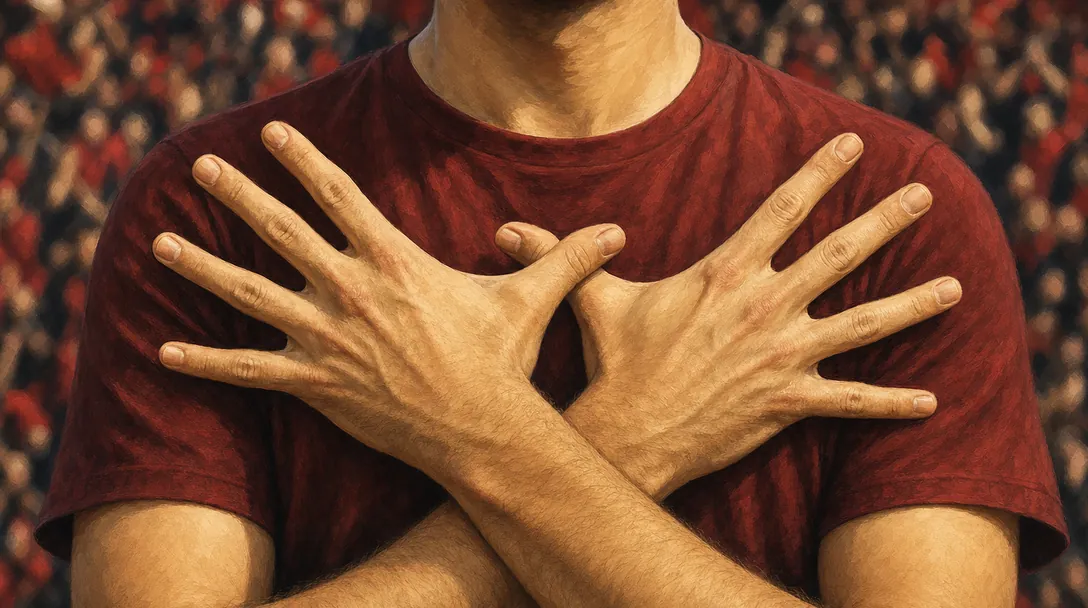
Albanians make the eagle with their hands. The palms are crossed over each other with the thumbs hooked together: these are the two heads, while the spread fingers are the feathers of the wings. You will see the gesture at weddings and concerts, and especially in stadiums.
The best-known case came at the 2018 World Cup. On 22 June in Kaliningrad, Switzerland beat Serbia 2–1, and Granit Xhaka and Xherdan Shaqiri, Swiss players from Kosovo Albanian families, celebrated their goals with the eagle. FIFA did not suspend them, but fined each of them 10,000 Swiss francs for unsporting behaviour. In Serbia the gesture was seen as a provocation.
Albania's national football team owes its nickname to the flag as well: Kuqezinjtë, “the Red and Blacks”. Less often the team is called Shqiponjat, “the Eagles”.
The Albanian flag and the flag of Kosovo
Kosovo declared independence on 17 February 2008 and has had its own official flag ever since: a blue field with a golden map of Kosovo and six white stars above it, one for each of Kosovo's largest ethnic groups. But for Kosovo Albanians the eagle flag remains the symbol of their people. At celebrations in Kosovo you see it at least as often as the official flag.
Our alphabet page will help you read flamur, shqiponjë and Shqipëria the Albanian way: all 36 letters come with audio, and you can listen to ë, q and sh on their own.
Frequently asked questions
Why is there a double-headed eagle on the Albanian flag?
A black double-headed eagle on red was the coat of arms of the Kastrioti family, to which Skanderbeg, the 15th-century national hero, belonged. The symbol itself came to the Balkans from Byzantium. When Albania became independent in 1912, the flag with this eagle became the national flag.
What do the colours of the Albanian flag mean?
They have no official meaning: the Constitution and the law only describe the flag. People usually say that red stands for blood and courage and black for steadfastness, but this is a popular interpretation.
When is Flag Day in Albania?
On 28 November, the anniversary of the proclamation of independence in Vlorë in 1912. The Constitution calls the holiday Flag Day; in everyday speech it is Independence Day.
How is the Albanian flag different from the flag of Kosovo?
The Albanian flag shows a black double-headed eagle on red. The official flag of Kosovo, adopted in 2008, is blue, with a golden map and six white stars. Kosovo Albanians, however, often use the Albanian flag as well.
What does the eagle gesture mean?
It is a double-headed eagle made with the hands: the linked thumbs are the heads and the other fingers the wings. For Albanians it is a sign of pride. In Serbia it is seen as a challenge, which is why the gesture caused a scandal and FIFA disciplinary proceedings at the 2018 World Cup.
Why was the star removed from the Albanian flag?
The red star with a gold border was added in 1946, under the communists. After the fall of the regime, on 7 April 1992, the new People's Assembly restored the flag without the star.
Sources
- Kushtetuta e Republikës së Shqipërisë
- Wikipedia: Flag of Albania
- Wikipedia: List of Albanian flags
- Britannica: Flag of Albania
- Britannica: Skanderbeg
- Wikipedia: Names of the Albanians and Albania
- Kunsthistorisches Museum Wien: Helmet of Skanderbeg
- Wikipedia: Himni i Flamurit
- Euronews: Swiss players fined but not suspended for the eagle gesture (2018)
- Britannica: Flag of Kosovo
- Flags of the World: Albania